“I hear and I forget, I see and I remember, I do and I understand”
The Chinese saying from the 5th century BC, often attributed to Confucius, encapsulates the essence of experiential learning; learning that unfolds naturally through experience and the activation of the senses, through exploration, trial, and experimentation. It is a form of learning that constitutes an active, dynamic, and creative process of discovering knowledge, focusing on the emergence of genuine interest rather than on a “right” or “wrong” outcome.
Educator Sophia Roque-Melas, who so recently and prematurely passed away, devoted herself wholeheartedly to the promotion of experiential learning and interdisciplinary approaches to knowledge. Through her work and dedication, she transformed the educational landscape in contemporary Greece, inspiring thousands of educators, children, and parents. At the Hellenic Children’s Museum, which she founded, I had the great fortune and honor, beginning in 1992, to be firstly her student and later her collaborator, designing and implementing experiential educational programs for families, school groups, and children of all ages.
In 2011, I first heard the story of the creation of the Mt. Hymettus Aesthetic Forest from its Technical Director, Dr. Nikos Pangas. Inspired by this remarkable example of vision, dedication, and love for nature, I immediately proposed my collaboration in the design and implementation of experiential educational programs, with the aim of fostering environmental awareness among children and adults, as well as promoting the important work of Philodassiki.
Philodassiki embraced the proposal with enthusiasm, as the organization’s statutes explicitly identify “the information, awareness-raising, and education of the public, and especially of young people, in the field of Environmental Education” as one of the key means of fulfilling its mission to protect and preserve the natural environment.
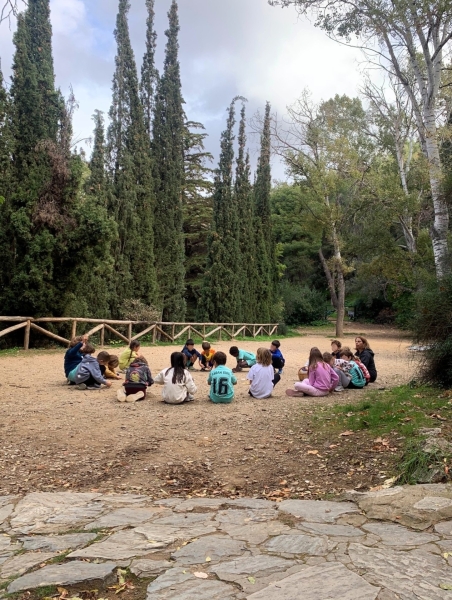
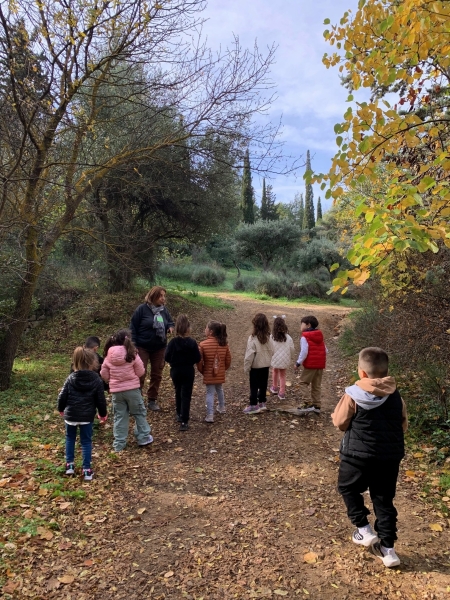
Thus began a collaboration that now spans 14 years. Within Philodassiki’s educational programs for school groups of children aged 4 to 15, experiential learning becomes lived reality and environmental education an active process. In each program, the needs, capacities, and dynamics of the group are identified, shaping and co-creating the course of the learning experience.
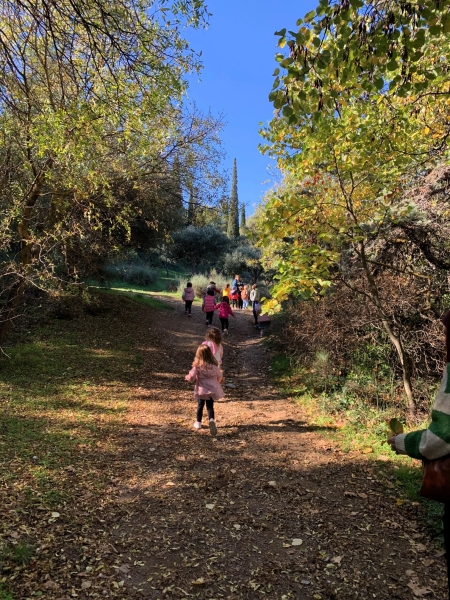
Children of all ages participate actively, exploring and discovering knowledge while connecting with the natural world of the forest through all their senses: they listen to the language of birds, observe dozens of different colors, breathe in new scents, touch the varied textures of natural materials, taste fruits, walk and balancing on soil, stones, and wood, move freely, and inhale the life-giving air of the forest.
By observing and discovering the “wonders” of the natural world, guided by their innate curiosity, children ask questions and seek answers, activating their critical thinking. By following the distinct qualities and functions of each season, they come to understand their significance and become familiar with the changes these seasons bring – both around them and within themselves.
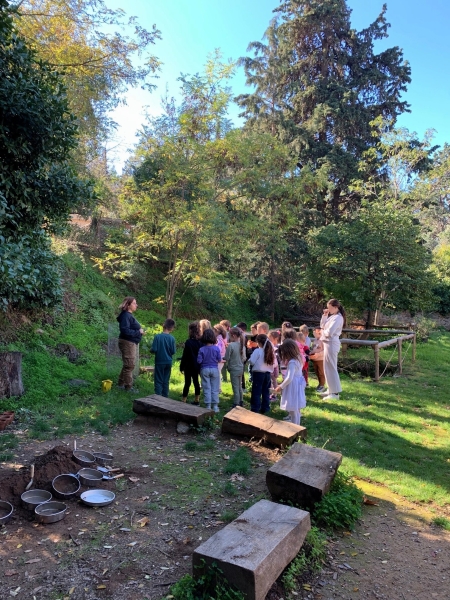
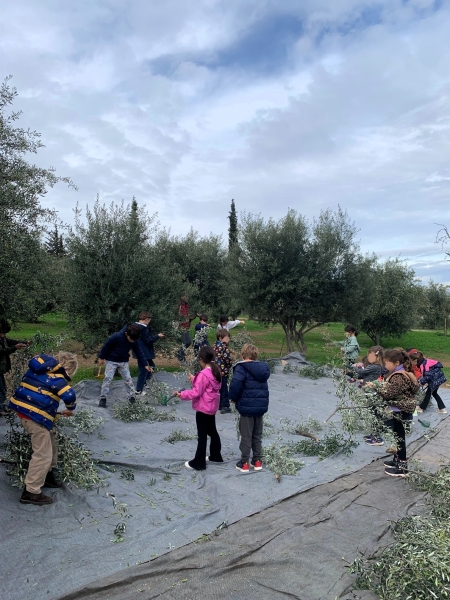
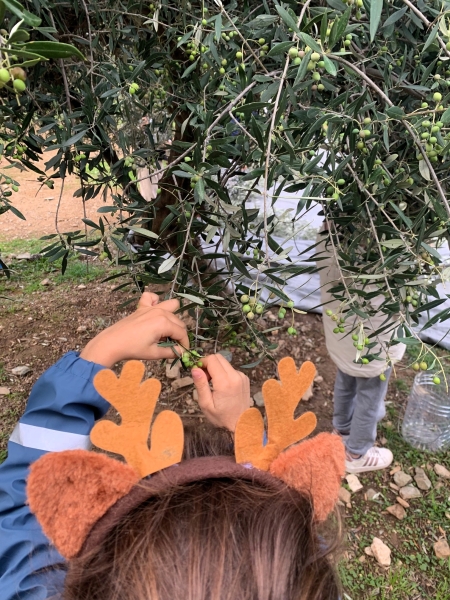
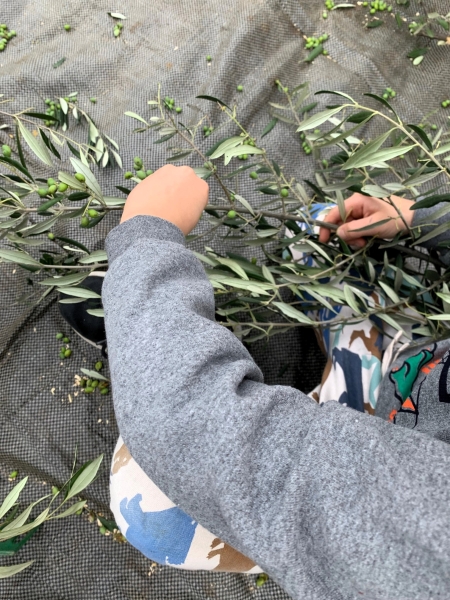
At this time of year, among winter’s gifts, we are discovering olives once again. After two years of drought, the branches of the olive trees in the Historical Olive Grove of the Aesthetic Forest are once more laden with fruit, offering us another opportunity for experiential connection with nature. In the olive-harvesting educational program, children actively participate by picking olives by hand and with small rakes, continuing a tradition thousands of years old and forming a direct link with the history and culture of this land.
They work together toward a shared goal and, after separating the olives they have gathered from the leaves, collect them into sacks. Through this process, they come to realize that producing just one liter of olive oil requires many hands, great effort, and approximately seven kilograms of olives. The natural question that arises within the group, “What will happen to the oil?”, is answered by explaining that Philodassiki has always donated part of its olive oil to institutions in need, offering a powerful example of generosity, solidarity, and empathy.
By tasting olives and rusks with olive oil and oregano, the children complete their experience through flavor, rooted in the foundations of a healthy Mediterranean diet. As they depart, with a sense of fulfillment, they carry with them a unique and unforgettable memory that will stay with them for a long time, expressing how much they enjoyed the experience and how eager they are to repeat it.
And somewhere here, in just this way, hope is born for a sustainable and resilient future on planet Earth.
Roza Triantafyllidi | Educator - Forest School Leader (Level 3), Head of Educational Programs at Philodassiki
[December 2025]